Groundwater resources
Most parts of the BUPUSA basins have basement complex rocks such as granites and gniesses (Figure 7). These rocks are primarily impermeable. Groundwater occurs whether is weathering to significant depths, and/or the occurrence of fissures and fractures that impart secondary permeability. Aquifers in these formations are generally of local importance supporting for village water supply. Most boreholes have depths of 30 – 60 m and yield 1 litre/sec.
Unconsolidated sedimentary rocks occur on the lower parts of the three basins (Figure 7). Aquifers in these formations have high productivity, greater than 10 litres/sec. The most significant groundwater resource occurs within the unconsolidated sedimentary Save alluvium in Zimbabwe which covers about 1350 km2 along the Save River (Figure 7). This aquifer and water released from the upstream Osborne Dam on the Odzi River support irrigation of about 15 000 hectares including at Nyanyadzi, Middle Save, Chibuwe and Chisumbanje. The Save alluvial aquifer is not transboundary in terms of spatial extent. However, groundwater abstraction from this aquifer can induce recharge from the Save River flows which can have transboundary effects. During the dry season, most of the flows of the Save River along the stretch with the alluvial aquifer are due to water releases from Osborne Dam. Hence the transboundary implications of groundwater abstractions are not clear cut. There has also been a suggestion that water abstracted from boreholes for irrigation is in some cases surface water which will have recharged the alluvial aquifer. A potential exists for double counting the same water, i.e. surface water from the Osborne Dam is then counted as groundwater after recharging the alluvial aquifer.
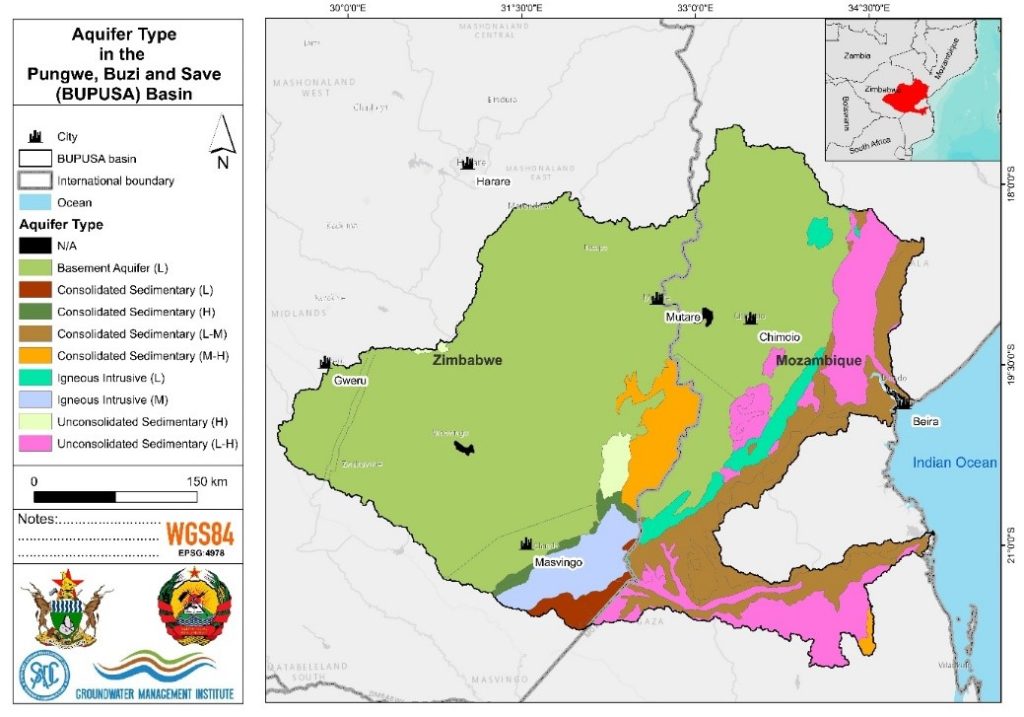
Figure 7: The productivity of aquifers within the BUPUSA Basin. (L) = low productivity 0.01 – 1 litre/sec, (M) = moderate productivity 1 – 10 litres/sec, (H) = high productivity > 10 litres/sec.
VisionRI (2020) estimated groundwater recharges rates and then assumed that 10% of this can be sustainably utilized in the Save Basin in Zimbabwe. On this basis the available groundwater resource for the Save Basin in Zimbabwe was estimated to be 780 Mm3/yr (Runde Catchment 250 Mm3/yr; Save Catchment in Zimbabwe 530 Mm3/yr). SWECO (2011) used the same approach but assumed that 55% of groundwater recharge can be utilized in Buzi Basin. The available groundwater in the whole Buzi Basin was estimated to be 1257 Mm3/yr. Using the same approach, the available groundwater resources in the Pungwe Basin is estimated to be 1628 Mm3/yr.